Monday, May 22, 2024

Pet Shampoo OEM Quality Checks Before Ordering
by
Published
Views:
Before approving a petshampooOEM order, quality control and safety teams must verify far more than fragrance, viscosity, or label design. A reliable supplier should demonstrate compliant formulations, microbiological stability, packaging integrity, batch traceability, and documentation aligned with target-market regulations. This guide outlines the essential quality checks procurement and compliance teams should complete before placing an order, helping reduce recall risks, protect animal safety, and ensure consistent product performance from pilot samples to mass production.
For B2B buyers, pet shampoo outsourcing is a regulated consumer-safety decision, not just a packaging project. One missed specification can affect 10,000 bottles or more.
Quality control personnel and safety managers need a measurable checklist before purchase order approval. The goal is to verify evidence, not rely on supplier promises.
Supplier Qualification Before a petshampooOEM Purchase
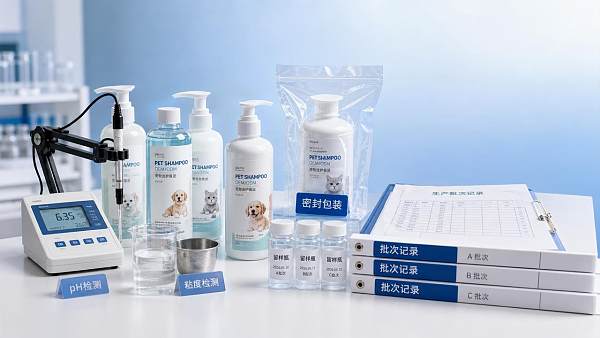
A capable petshampooOEM supplier should operate with documented controls across formulation, procurement, filling, labeling, storage, and shipment. Factory appearance alone is not enough.
Initial qualification should include at least 6 verification points: business scope, production environment, quality system, raw material controls, laboratory capability, and complaint handling.
Check the Manufacturing Scope
Confirm whether the site actually produces pet care liquids or only repacks bulk products. OEM shampoo requires mixing, filtration, filling, and batch release discipline.
Ask whether the supplier handles 500 kg pilot batches and larger commercial batches, such as 2,000–5,000 kg, using validated equipment and controlled procedures.
Review Quality System Evidence
For petshampooOEM sourcing, request quality manuals, internal audit records, calibration logs, deviation procedures, and change-control templates from the previous 12 months.
Certificates are useful, but the stronger signal is traceable execution. A supplier should explain how nonconforming batches are quarantined within 24 hours.
The table below summarizes qualification checks that procurement, QC, and safety teams can apply before moving from quotation to trial production.
The key conclusion is simple: a petshampooOEM vendor should be judged by repeatable controls. Good samples without documented systems create avoidable risk.
Formulation Safety and Performance Checks
Pet skin differs from human skin, so a pleasant foam profile is not sufficient. Safety teams must assess irritation potential and species suitability.
A typical dog shampoo may target a pH range around 6.0–7.5, while some formulations need different limits based on positioning and ingredients.
Ingredient Compliance Review
Before confirming a petshampooOEM formula, request the full ingredient list, concentration ranges, preservative system, fragrance allergens, colorants, and functional claims.
If the product will be sold in 2 or more markets, label wording and ingredient restrictions should be reviewed by target-market specialists.
Avoid vague statements such as “natural and safe” without specifications. Plant extracts, essential oils, and deodorizing agents still require concentration and compatibility review.
Physical and Chemical Test Parameters
QC teams should define measurable release criteria before ordering. At minimum, each batch should be checked for appearance, odor, pH, viscosity, and net content.
- pH: set a formula-specific range, commonly within a 0.5–1.0 pH unit acceptance window.
- Viscosity: define method, spindle, speed, temperature, and acceptable variation, such as ±10% from approved standard.
- Appearance: require no separation, sediment, discoloration, or visible contamination after storage checks.
- Odor: compare against a retained reference sample approved during pilot validation.
Pilot Batch Confirmation
A pilot batch should not be treated as decoration for sales approval. It is the bridge between laboratory formula and commercial production.
For petshampooOEM projects, compare at least 3 retained samples: lab sample, pilot batch sample, and first commercial batch sample.
Microbiological Stability and Preservation Control
Liquid pet shampoo contains water, surfactants, botanical additives, and fragrances that can support contamination if preservation is poorly designed or production hygiene fails.
Microbial risk is especially important for products used near damaged skin, puppies, senior pets, or grooming salons handling 20–50 animals daily.
Routine Microbial Limits
The supplier should provide microbial limit testing on finished products according to recognized cosmetic or pet care methods suitable for the destination market.
Common controls include total aerobic microbial count, yeast and mold count, and absence checks for specified objectionable organisms in representative samples.
Preservative Effectiveness and Storage
A petshampooOEM formula with high botanical content may need preservative challenge testing or equivalent justification before large-scale release.
Stability studies often include accelerated conditions such as 40°C for 4–8 weeks, plus ambient storage for longer-term observation.
- Confirm microbial specifications before sampling begins.
- Verify water system monitoring and sanitation frequency.
- Review preservative compatibility with surfactants and fragrance.
- Test retained samples after filling and after storage exposure.
- Document every deviation with corrective and preventive actions.
These 5 steps help safety managers distinguish between a stable formula and one that only looks acceptable during early sampling.
Packaging Integrity and Label Verification
Packaging failure can turn a technically acceptable petshampooOEM batch into a costly customer complaint. Leakage, panel collapse, or unreadable labels damage trust.
Packaging checks should include bottle compatibility, closure torque, pump function, induction sealing if used, carton strength, and transport simulation.
Bottle and Closure Compatibility
Surfactant systems and fragrances can stress certain plastics over time. Ask for compatibility checks under room temperature and elevated temperature conditions.
For pump bottles, test at least 30–50 actuations per sample group to confirm smooth dispensing, no blockage, and stable dose volume.
Label Claims and Regulatory Alignment
Claims such as “anti-itch,” “medicated,” “flea control,” or “antibacterial” may trigger additional regulatory scrutiny depending on the destination market.
Quality teams should approve artwork only after checking ingredient declaration, batch code position, net content, directions, warnings, and responsible party details.
The following packaging and labeling table supports practical acceptance decisions before final petshampooOEM production release.
The main lesson is that packaging acceptance must reflect real logistics. A 300 ml bottle and a 5 L refill pack need different tests.
Batch Traceability, Documentation, and Release Control
Traceability is central to recall prevention. A petshampooOEM supplier should connect every finished batch to raw material lots and production records.
If a complaint occurs, the buyer should identify affected units within hours, not spend 3–5 days reconstructing production history.
Documents to Approve Before Ordering
Before placing a purchase order, require a document package that includes specifications, approved formula, artwork proofs, test methods, and release criteria.
- Finished product specification with physical, chemical, microbiological, and packaging requirements.
- Batch manufacturing record template showing mixing sequence, temperature, time, and operator checks.
- Certificate of analysis format linked to each production lot.
- Deviation and change-control procedure covering raw material substitutions.
- Retention sample policy, commonly covering at least shelf life plus 6 months.
Release Gates for Mass Production
A practical release process uses 3 gates: pre-production approval, in-process control, and final batch release after laboratory review.
Do not allow shipment based only on visual inspection. For petshampooOEM orders, final release should match the approved specification line by line.
Change Control Discipline
Raw material shortages are common in global manufacturing. Any surfactant, preservative, fragrance, bottle, or label change should require written buyer approval.
GIM-style technical benchmarking emphasizes cross-sector transparency: the same discipline used in electronics or mobility supply chains applies to pet care manufacturing.
Audit Strategy for QC and Safety Teams
An audit does not need to be overly complex, but it must be focused. Plan around product risk, order volume, and market exposure.
For a first petshampooOEM order above 10,000 units, a remote document audit plus on-site or third-party inspection is often appropriate.
Recommended Audit Flow
- Screen the supplier using a 20–30 question technical questionnaire.
- Review documents, certificates, formula controls, and previous test reports.
- Inspect production areas, water system, filling lines, warehouse, and laboratory.
- Approve pilot production only after closure of critical findings.
- Perform pre-shipment inspection using defined sampling and acceptance criteria.
This 5-step audit flow gives safety managers a defendable process when internal stakeholders ask why one supplier was approved over another.
Common Red Flags
Warning signs include reluctance to share formulas under confidentiality, inconsistent COA formats, missing retention samples, uncontrolled rework, and undocumented fragrance substitutions.
Another red flag is a supplier offering aggressive delivery, such as 7 days for new mass production, without stability or packaging validation.
Procurement Decisions and Long-Term Risk Reduction
The lowest quotation is rarely the lowest total cost if recalls, relabeling, leakage, or customer complaints appear after market launch.
A balanced petshampooOEM scorecard should combine quality capability, compliance readiness, delivery stability, communication response, and corrective-action maturity.
Build a Practical Supplier Scorecard
Use weighted evaluation rather than a single price comparison. For example, assign 40% to quality, 25% to compliance, 20% to delivery, and 15% to service.
Such weighting supports transparent internal decisions and helps procurement avoid approving a supplier that cannot support long-term brand protection.
When to Escalate Testing
Escalate external laboratory testing when claims are sensitive, formulas contain novel ingredients, order volume exceeds the pilot plan, or complaints indicate repeat defects.
For high-risk launches, consider testing 3 production lots before full rollout. This helps confirm process consistency beyond the first successful batch.
How GIM Supports Better Decisions
Global Industrial Matrix approaches petshampooOEM evaluation as part of a wider manufacturing-risk framework, where data transparency and technical benchmarking guide supplier selection.
By applying cross-sector discipline from regulated production environments, QC teams can convert scattered supplier claims into structured evidence and actionable controls.
Before approving your next petshampooOEM order, verify supplier capability, formula safety, microbial stability, packaging integrity, traceability, and release documentation. These checks protect animals, retailers, and brand reputation.
If your team needs a supplier audit checklist, technical benchmarking support, or a risk-based order approval framework, contact GIM to explore more solutions.

The Archive Newsletter
Critical industrial intelligence delivered every Tuesday. Peer-reviewed summaries of the week's most impactful logistics and market shifts.