Monday, May 22, 2024

Brazil Starts INMETRO Energy Label Rule for CNC Imports
by
Published
Views:
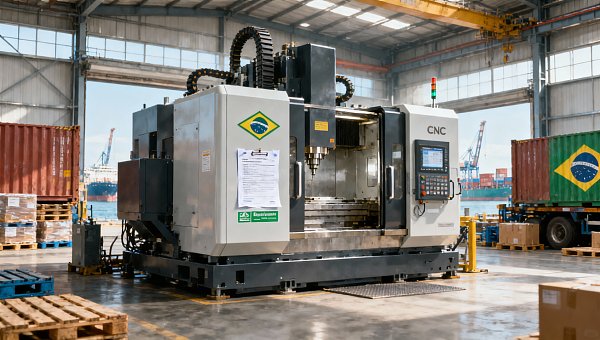
On July 1, 2026, Brazil began enforcing a new import compliance requirement for CNC machining tools: covered machines entering the country now need the INMETRO 004/2026 energy efficiency label together with test reports on IE3 motor efficiency and no-load power consumption issued by a laboratory recognized by Brazil's CNEN. For exporters, importers, equipment buyers, and logistics teams handling CNC machining centers, five-axis milling machines, and mill-turn equipment, this is worth close attention because non-compliant shipments can be held at port, turning a technical documentation issue into a direct delivery and trade risk.
What the rule now requires at entry into Brazil
According to the provided information, INMETRO stated that from July 1, 2026, all CNC machining centers, five-axis milling machines, and mill-turn machines imported into Brazil must carry the INMETRO 004/2026 energy efficiency label.
The same requirement also includes submission of test reports covering IE3 motor efficiency and no-load power consumption. These reports must be issued by a laboratory recognized by Brazil's CNEN.
The rule applies to all CNC main machine equipment with power above 7.5 kW. Products without the required label will be detained at the port.
Where the immediate pressure is likely to appear
Export transactions may face a documentation bottleneck
From an industry perspective, exporters shipping CNC machine tools to Brazil are likely to be affected first because the new rule is tied directly to import clearance. The practical impact is likely to center on product scope checks, label readiness, and whether the required test reports are complete before shipment.
What deserves closer attention is that the risk described in the notice is not only about technical conformity in principle, but also about whether a shipment can physically move through the port without detention.
Importers and distributors may need tighter pre-shipment controls
Analysis shows that Brazilian importers and channel operators may face pressure at the order confirmation and customs preparation stages. If covered machines arrive without the required label or supporting reports, the disruption may fall on inventory planning, customer delivery commitments, and coordination with customs and port-side service providers.
For these market participants, the key issue is likely to be front-end verification rather than post-arrival correction.
Manufacturers and engineering teams may need closer alignment on covered models
Observably, equipment manufacturers and technical teams may be affected where model classification, motor specification confirmation, and test-document matching are concerned. Because the rule covers CNC main machine equipment above 7.5 kW, businesses involved in configuring or customizing machines for Brazil may need to confirm early whether a given machine falls within the mandatory scope.
Supply chain and delivery service providers may see higher coordination demands
Supply chain service providers, including freight and delivery coordinators, may also be affected indirectly. The main pressure point is likely to be schedule reliability, since a missing label or report can shift a routine shipment into an exception case that requires additional communication between exporter, importer, and port-side parties.
What companies should check now
Confirm whether product lines fall within the mandatory scope
Companies should first map which machines in their Brazil-bound portfolio are CNC machining centers, five-axis milling machines, or mill-turn equipment, and then check whether the machine power exceeds 7.5 kW. This is the threshold explicitly identified in the provided information.
Review whether label and test documents are prepared as a matched set
What deserves closer attention is the link between the physical labeling requirement and the supporting test documentation. The rule, as provided, does not describe these as separate optional items. Businesses involved in shipment preparation should therefore focus on whether the INMETRO 004/2026 label and the CNEN-recognized laboratory reports are aligned to the same machine and shipment.
Factor compliance timing into shipment and delivery commitments
Analysis shows that this is not only a regulatory matter but also a delivery-timing issue. Where contracts, production schedules, or customer acceptance plans depend on customs arrival dates, companies may need to build in additional internal checks before dispatch to reduce the chance of port detention.
Keep watching for official wording and operational interpretation
Although the core requirement in the provided information is clear, businesses should continue to watch how official language, customs practice, and documentary review are applied in actual transactions. The distinction between a published rule and day-to-day enforcement details can matter significantly in cross-border equipment delivery.
Why this should be read as more than a routine paperwork update
Analysis shows that the immediate meaning of this development is straightforward: energy-efficiency compliance has become a direct market-entry condition for covered CNC machine tools shipped to Brazil. That changes the issue from a technical afterthought into a shipment-gating requirement.
It is more appropriate to understand this as an already effective compliance change with ongoing operational implications, rather than as a distant policy signal. At the same time, it should still be watched as an evolving industry development because the practical burden will depend on how consistently the labeling and report requirements are checked across real import cases.
How the market may need to interpret the July 2026 change
From an industry perspective, the significance of this update lies less in broad market prediction and more in execution discipline. For companies exporting CNC machine tools to Brazil, the current issue is not whether the rule exists, but whether product scope, labeling, test reports, and shipment preparation are being managed as one connected process.
At this stage, the most balanced reading is that the rule represents a concrete compliance threshold for affected equipment, while its wider commercial effects still need to be observed through actual trade and delivery practice.
Basis of this article and points still requiring verification
This article is based on the user-provided news title, event date, and event summary concerning the INMETRO requirement taking effect on July 1, 2026 for CNC machine tools exported to Brazil.
For developments of this kind, commonly relevant source types include official notices, company announcements, industry association updates, authoritative media reports, and standard-related documents. A specific official source link was not provided in the input, so the exact original publication and any later clarification still need ongoing verification.
Further attention should remain on any subsequent official wording, operational guidance, and enforcement interpretation related to product scope, labeling practice, and document review at import.

The Archive Newsletter
Critical industrial intelligence delivered every Tuesday. Peer-reviewed summaries of the week's most impactful logistics and market shifts.