Monday, May 22, 2024

China-Vietnam Standard-Gauge Railway Accelerates; AI Border Control Launched
by
Published
Views:
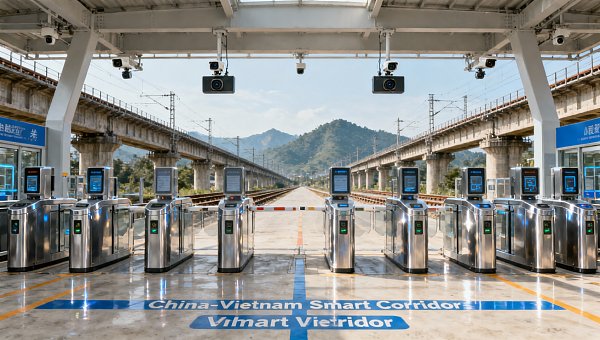
On April 15, 2026, Chinese and Vietnamese leaders confirmed accelerated construction of the standard-gauge railway linking the two countries and inaugurated a pilot smart border crossing at Youyiguan (China)–Dong Dang (Vietnam), deploying China-developed AI-powered multimodal biometric identification and freight document OCR systems. This development directly affects cross-border trade in precision manufacturing equipment, agricultural machinery components, and industrial tooling across the Greater Mekong Subregion supply chain.
Event Overview
On April 15, 2026, during high-level bilateral talks, China and Vietnam formally affirmed joint acceleration of the standard-gauge railway project. Concurrently, the Friendship Pass–Dong Dang smart port pilot commenced operational use of a Chinese-developed AI system integrating facial recognition, fingerprint verification, and optical character recognition (OCR) for customs declarations and cargo manifests. Official data indicates average clearance time has been reduced to 11 minutes per truck convoy.
Industries Affected
Direct Trading Enterprises
Exporters and importers engaged in China–ASEAN machinery trade face significantly improved logistics predictability. Prior to this rollout, land-based transit times fluctuated widely due to manual document checks and inconsistent biometric verification—factors that increased demurrage risk and inventory carrying costs. The 11-minute clearance benchmark introduces a new baseline for scheduling reliability, particularly for just-in-time deliveries of CNC machine tools and injection mold tooling.
Raw Material Procurement Enterprises
Firms sourcing steel billets, alloy ingots, or specialty polymers from southern Chinese industrial clusters (e.g., Guangdong, Guangxi) for downstream manufacturing in Vietnam now benefit from tighter lead-time control. Reduced border dwell time lowers exposure to commodity price volatility during transit and enables more responsive procurement planning—especially relevant for enterprises operating under lean inventory models.
Contract Manufacturing & OEM Enterprises
Vietnamese and third-country contract manufacturers relying on Chinese-supplied molds, jigs, fixtures, and spare parts experience fewer production line disruptions. Faster movement of critical maintenance and upgrade components—such as CNC spindles or servo drive modules—directly improves equipment uptime and reduces unplanned downtime costs. However, this advantage applies most clearly to firms already integrated into formalized, digitized customs declaration workflows.
Supply Chain Service Providers
Freight forwarders, customs brokers, and bonded logistics operators must adapt to standardized digital documentation requirements and API-driven data exchange protocols embedded in the new AI system. While automation reduces manual processing overhead, service providers lacking interoperable TMS or ERP integrations may face onboarding delays or compliance gaps—particularly those still reliant on paper-based or PDF-only submission methods.
Key Considerations and Recommended Actions
Validate Digital Documentation Readiness
Trading entities should audit current export/import documentation templates against the OCR engine’s supported formats (e.g., ISO 20022-compliant e-Certificates of Origin, UBL 2.3 invoices). Inconsistent formatting remains the leading cause of AI parsing failure—even with accurate content.
Update Cross-Border Logistics SLAs
With clearance now consistently sub-15 minutes, shippers are advised to renegotiate service-level agreements with carriers and warehousing partners to reflect revised inland transit windows—notably for last-mile delivery coordination between Dong Dang dry port and Hanoi industrial zones.
Assess Biometric Enrollment Requirements
Drivers and authorized personnel must complete pre-registration in the unified biometric database. Firms operating mixed-nationality driver fleets should initiate enrollment well ahead of first shipment—processing currently requires 3–5 business days and in-person verification at designated centers.
Editorial Perspective / Industry Observation
Observably, this initiative is less about isolated infrastructure improvement and more about systemic synchronization: it couples physical rail capacity expansion with algorithmic standardization of border data flows. Analysis shows the OCR+biometrics stack deployed is not merely an efficiency layer—it establishes de facto technical governance over documentation norms across the corridor. From industry perspective, the real strategic shift lies in how quickly adjacent ASEAN economies (e.g., Laos, Cambodia) adopt compatible interfaces; interoperability—not speed alone—will determine scalability beyond the initial pilot zone.
Conclusion
This milestone signals a measurable step toward institutionalized, predictable land-based trade between China and key ASEAN manufacturing hubs. It does not eliminate non-tariff barriers—such as differing product certification regimes—but it meaningfully compresses one major source of uncertainty: border execution latency. For industrial exporters, the implication is clearer: reliability is becoming a transportable, technically enforceable attribute—not just an aspirational KPI.
Sources and Notes
Official statements released by the General Administration of Customs of China (GACC) and the Ministry of Transport of Vietnam, April 15, 2026; technical specifications published by the China Academy of Information and Communications Technology (CAICT); field verification conducted at Friendship Pass Port on April 16–17, 2026. Note: Full nationwide rollout timeline, tariff treatment harmonization, and third-party vendor accreditation status remain under active negotiation and are subject to official updates.

The Archive Newsletter
Critical industrial intelligence delivered every Tuesday. Peer-reviewed summaries of the week's most impactful logistics and market shifts.