Monday, May 22, 2024

Flotation Machines: Common Recovery Problems and Fixes
by
Published
Views:
Why do flotationmachines suddenly lose recovery?
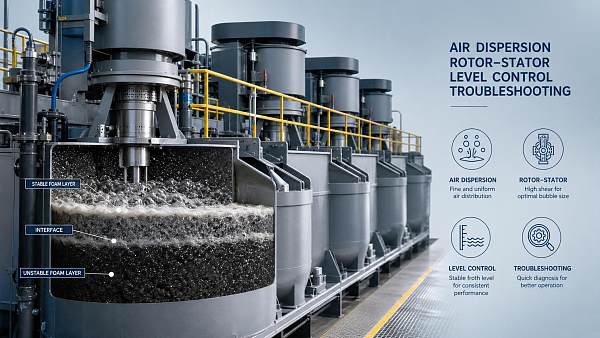
Recovery loss in flotationmachines rarely comes from one dramatic failure. More often, several small deviations stack up and push the circuit away from stable separation.
The first visible sign is usually unstable froth. Grade slips, tailings rise, or air demand changes without a clear reason. That is where diagnosis should begin.
In practical plant work, recovery problems often sit at the intersection of mechanics, reagents, slurry condition, and control settings. Treating only one variable can hide the real fault.
This matters across modern industry because flotation supports mineral inputs used in electronics, mobility systems, water treatment, and precision manufacturing supply chains.
That cross-sector view is important. GIM tracks how equipment reliability and benchmarked maintenance practices influence broader manufacturing resilience, not just isolated unit performance.
So when flotationmachines underperform, the best question is not only what failed, but what changed first, what drifted next, and what evidence confirms the sequence.
Is the froth telling you the real problem, or just the symptom?
Operators often describe bad recovery as a froth issue, and that is partly true. Froth behavior is the easiest visual clue, but it is not always the root cause.
A weak, watery froth usually points toward low air dispersion, poor reagent balance, or solids changes. A heavy, overloaded froth may suggest too much collector or entrainment.
It helps to separate appearance from mechanism. Dense bubbles do not automatically mean better mineral attachment, and persistent foam does not guarantee selective recovery.
More useful checks include air flow stability, froth depth trend, pulp level response, and whether the surface mobility changes after dosage corrections.
When flotationmachines show froth instability in one bank only, compare cell-by-cell air rate, stator wear, and feed distribution before changing the entire reagent program.
If the whole line looks erratic, look upstream. Grinding size, cyclone split, water quality, and density swings can reshape flotation conditions long before froth collapses.
A quick field check often starts here
- Watch whether froth breaks immediately or carries mineral to discharge.
- Compare air valve position with actual airflow, not setpoint alone.
- Confirm pulp level instrumentation against manual measurement.
- Check if reagent addition changed before recovery dropped.
- Inspect whether one cell is driving the entire bank off balance.
Which faults in flotationmachines most often reduce recovery?
Some faults appear everywhere because they directly affect bubble generation, particle attachment, or retention time. These are the issues worth checking before deeper redesign work.
The table below works as a fast troubleshooting reference. It is especially useful when symptoms overlap and the plant needs a disciplined first response.
The value of this approach is speed. Instead of guessing, the team can link each symptom in flotationmachines to a check, a cause, and a practical fix.
That is also where benchmarking helps. GIM-style comparison across plants and equipment generations makes repeat failures easier to recognize and prioritize.
When should you blame reagents, and when should you not?
Reagents are often blamed first because they are easy to adjust. That convenience can create a costly habit. Many recovery problems in flotationmachines are mechanical or hydraulic.
A collector increase may temporarily boost mass pull, yet still hide poor air dispersion or bad residence distribution. The circuit then becomes more expensive and less selective.
A better rule is simple. If recovery shifted suddenly, check dosing delivery, reagent age, and mixing point. If it drifted slowly, inspect wear and control bias as well.
Water chemistry also matters more than many teams expect. Hardness, recycled water contamination, and dissolved ions can change froth character and collector response.
In actual troubleshooting, pH correction should be confirmed with independent measurement. Faulty probes create long periods of wrong chemistry while the displayed value looks normal.
If reagent changes improve one shift but fail on the next, the issue may be feed variability rather than dosage. That is a different control problem entirely.
Signs the problem may not be reagent-related
- Recovery drops only in cells with visible wear.
- Airflow readings drift from physical froth behavior.
- Pulp level hunts despite stable setpoints.
- Mechanical noise increases before metallurgical loss appears.
- Reagent changes produce inconsistent responses across shifts.
How do worn parts and poor airflow show up in daily operation?
Airflow problems are among the most common hidden causes of poor recovery in flotationmachines. The machine still runs, but the bubble population no longer supports efficient attachment.
Rotor and stator wear typically reduce shear efficiency. Bubbles get larger, air distribution becomes uneven, and one section of the cell may carry most of the useful froth.
Air leaks can be equally damaging. A small leak upstream of the cell may lower effective air delivery while the control valve position suggests everything is acceptable.
In some plants, the problem appears after a routine shutdown. Reassembled parts may meet basic fit requirements yet still miss the original clearance or alignment target.
That is why condition history matters. Tracking wear life, rebuild intervals, and part quality across different flotationmachines usually reveals patterns long before failure becomes obvious.
For sites serving diversified industrial supply chains, that discipline supports more predictable output and fewer disruptions in downstream metal-dependent production.
What is the fastest way to restore recovery without creating a new problem?
Fast recovery restoration depends on sequence. The safest order is to verify measurements, isolate the failing area, correct mechanics, then fine-tune chemistry and operating targets.
Jumping straight to aggressive reagent changes may recover concentrate mass, but it often harms grade, raises consumption, and makes the circuit harder to stabilize later.
A disciplined response usually includes the following actions:
- Confirm instrument readings against manual checks.
- Identify whether the issue is single-cell, bank-wide, or upstream.
- Inspect air path, impeller condition, and pulp level control.
- Review recent reagent, ore, water, and maintenance changes.
- Make one controlled adjustment at a time and log the response.
This method is slower than guessing for ten minutes, but much faster than chasing the wrong variable for three shifts.
Where multiple sites operate similar flotationmachines, a shared fault library can shorten diagnosis time even more. That kind of structured learning aligns well with GIM’s benchmark mindset.
What should be documented after the fix, so the same loss does not return?
The repair itself is only half the job. Repeat recovery loss usually happens because the site restores performance but fails to capture the evidence behind the fix.
Record the symptom, confirmed cause, parts condition, setpoint changes, and metallurgical response over time. Include what did not work, because that prevents repeated trial-and-error.
It is also worth documenting feed conditions. Many flotationmachines are blamed for losses that really came from grind drift, solids variation, or upstream classification instability.
A short post-event review can define trigger limits for airflow, froth depth, pH, density, and wear. Those thresholds turn future troubleshooting into a faster judgment call.
Taken together, that creates a practical operating standard. It supports reliability, protects recovery, and gives the site a stronger basis for comparing assets, vendors, and maintenance cycles.
If recovery in flotationmachines has started slipping, the next step is straightforward: map the symptom, verify the measurements, rank likely causes, and test fixes in a controlled order.
That approach reduces downtime and builds better long-term decisions on parts, maintenance intervals, and process control priorities across the wider industrial system.

The Archive Newsletter
Critical industrial intelligence delivered every Tuesday. Peer-reviewed summaries of the week's most impactful logistics and market shifts.