Monday, May 22, 2024

Metal Stamping Tolerances: What Affects Part Quality Most?
by
Published
Views:
In metal stamping, tolerances are not just drawing limits. They shape assembly fit, electrical contact, sealing behavior, fatigue life, and inspection yield across industries that depend on repeatable formed parts.
That matters even more when stamped components move between sectors such as electronics, automotive systems, agri-tech equipment, and environmental infrastructure, where one dimensional shift can trigger broader system risk.
A practical review of metal stamping tolerances should therefore look beyond nominal dimensions. The real question is which variables most strongly influence part quality, and which ones deserve closer control first.
Why tolerance control has become a bigger issue
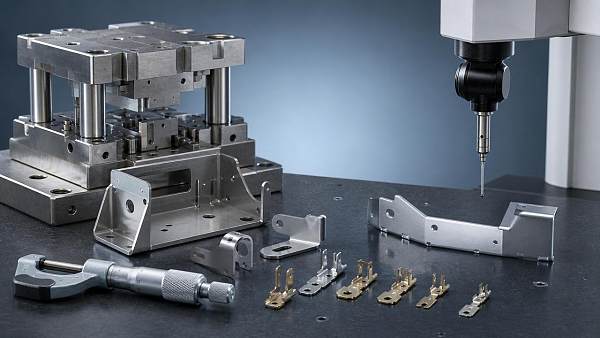
Stamped parts now serve tighter assemblies, lighter structures, and more integrated products. A bracket, shield, terminal, clip, or enclosure feature often interacts with sensors, fasteners, coatings, or automated assembly tools.
In that context, tolerance drift in metal stamping can create effects that do not appear obvious at the press. Problems may emerge later during welding, joining, leak testing, or end-of-line inspection.
This is one reason benchmarking platforms such as Global Industrial Matrix focus on cross-sector manufacturing signals rather than isolated process data. A tolerance issue in a precision tool can ripple into supply continuity, compliance exposure, and field performance.
What metal stamping tolerances really describe
Tolerance in metal stamping is often reduced to part size, but quality depends on a wider geometry set. Flatness, burr height, hole position, bend angle, springback, edge condition, and surface distortion can all matter as much as linear dimensions.
A part may pass a few caliper checks and still fail functionally. If the datum strategy is weak, or the critical interface is not measured correctly, the reported capability can look better than the actual assembly outcome.
This is especially common in progressive die work, where each station influences the next. Small variation accumulates through feeding, piercing, forming, restriking, and cutoff.
The difference between print tolerance and functional tolerance
Print tolerance is what appears on the drawing. Functional tolerance is what the downstream operation can actually accept without performance loss.
When these two are not aligned, metal stamping quality discussions become misleading. The part may be technically conforming while still creating scrap, noise, vibration, poor mating, or unstable contact pressure.
The variables that affect part quality most
Not every input has equal impact. In practice, several variables dominate metal stamping tolerance performance more than others.
Material behavior
Yield strength, tensile range, coating condition, grain direction, and thickness variation directly affect forming consistency. Two coils with the same nominal grade can still behave differently under the same die settings.
Higher strength alloys often amplify springback sensitivity. Thin conductive alloys used in connectors may react strongly to edge quality and punch condition.
Die design and die wear
Clearance, radii, stripper force, guide accuracy, and station balance determine how stable the process can be. As tooling wears, burrs grow, cut edges shift, and hole quality declines before obvious failure appears.
Wear is not only a maintenance issue. It changes the tolerance signature of the part, often gradually enough to escape routine checks.
Press and feed stability
Shut height variation, misfeed, vibration, lubrication inconsistency, and tonnage fluctuation can all widen process spread. In high-volume metal stamping, repeatability at speed matters more than a good first-off sample.
Measurement method
Inspection can distort the picture when fixturing, datum selection, sample frequency, or gauge capability is weak. Flexible stamped parts are especially vulnerable to false readings if they are measured without functional restraint.
Where tolerance problems show up first
The earliest warning sign is not always an out-of-spec dimension. Often it appears as unstable assembly behavior or increased adjustment in downstream operations.
In electronics, metal stamping issues may show up as inconsistent shielding fit, contact misalignment, or abnormal insertion force. In automotive systems, the same issue may appear as stack-up error, buzz-rattle complaints, or weld location drift.
In smart agri-tech and infrastructure hardware, tolerance loss can reduce sealing reliability, bracket alignment, or serviceability in outdoor conditions. The part may still look acceptable, but performance margins narrow quickly.
Common scenarios worth closer review
- Multi-bend components with tight positional relationships
- Thin-gauge parts with cosmetic or conductive requirements
- Features created late in a progressive die sequence
- Parts that rely on secondary welding, coating, or insert assembly
- Programs transferring between regions, presses, or tool maintenance cycles
How to judge metal stamping tolerance risk more accurately
A useful evaluation starts by separating critical features from routine ones. Not every tolerance carries the same business risk, and not every nonconformance threatens function.
The better approach is to link each critical dimension to a real interface, load path, electrical path, or sealing requirement. That changes the discussion from paperwork compliance to performance control.
Signals that deserve priority
- Cp and Cpk values that look acceptable, but only on limited sample windows
- Frequent die adjustments needed to keep angle or flatness stable
- Recurring discrepancies between inline gauges and lab measurements
- Part acceptance that depends heavily on operator sorting
- Supplier reports focused on dimensions, but not on burr, profile, or springback trends
Cross-sector benchmarking helps here. When tolerance capability is compared against standards such as ISO, IATF, or IPC expectations, hidden weaknesses become easier to detect before scale-up.
That broader view is valuable because metal stamping quality rarely fails for a single reason. Material control, tool condition, data discipline, and application context usually interact.
What improves consistency in real production
Most gains come from disciplined process control rather than chasing isolated defects. Stable metal stamping results depend on aligning design assumptions, tooling capability, and inspection logic.
Practical moves with strong impact
- Match material specifications to actual forming sensitivity, not just nominal grade
- Track tool wear by feature trend, not only by maintenance interval
- Use functional datums and restrained measurement for flexible parts
- Review tolerance stack-up with downstream joining and coating steps included
- Validate capability after process changes, coil changes, or die refurbishment
These actions are especially useful where component performance spans multiple systems. GIM’s system-level benchmarking perspective is relevant because a stamped part often supports a larger reliability chain, not just a local dimension check.
A better next step for evaluation
The most effective next step is to map tolerance requirements to actual failure modes. Which features affect fit, conductivity, sealing, fatigue, or automated handling most directly?
From there, compare material variation, die condition, process capability, and measurement discipline against those priorities. That creates a clearer basis for supplier review, tooling decisions, and risk mitigation.
Metal stamping quality improves when tolerance control is treated as a system question rather than a drawing-only question. That shift usually reveals what affects part quality most, and what should be addressed first.

The Archive Newsletter
Critical industrial intelligence delivered every Tuesday. Peer-reviewed summaries of the week's most impactful logistics and market shifts.