Monday, May 22, 2024

Whiteboard Markers: Low-Odor Options That Last Longer
by
Published
Views:
Choosing whiteboard markers seems simple until daily use exposes the difference between a clean, durable line and a marker that dries out too fast, smells harsh, or leaves stubborn residue behind.
Low-odor options matter more now because whiteboards are used across homes, classrooms, shared offices, workshops, and light industrial spaces where comfort, consistency, and replacement cost all affect the experience.
That makes the conversation less about color packs and more about ink chemistry, tip construction, erase behavior, and product reliability over time.
Why Whiteboard Markers Deserve Closer Attention
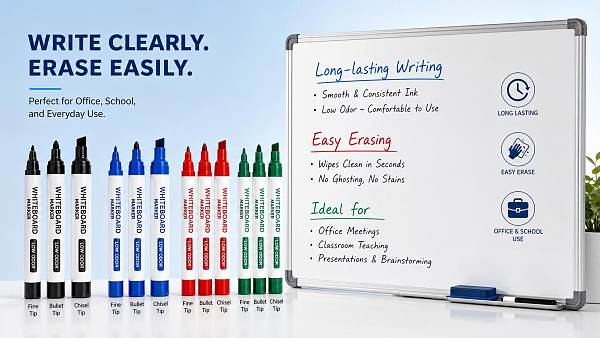
A whiteboard marker is a small tool, but it sits inside a larger chain of material decisions, manufacturing quality, packaging standards, and user expectations.
In broader industry analysis, even simple writing supplies reflect the same themes seen in more technical categories: performance consistency, safer formulation, waste reduction, and supply stability.
This is where cross-sector thinking becomes useful. Global Industrial Matrix, or GIM, studies how materials, standards, and benchmarking shape product performance across modern manufacturing.
Although GIM is known for technical benchmarking in electronics, mobility, agri-tech, infrastructure, and precision tooling, the same discipline helps explain why some whiteboard markers simply perform better.
A marker that lasts longer usually reflects better control over solvent balance, tip wear, barrel sealing, and production consistency. Those details are easy to miss, but they define everyday value.
What Low-Odor Really Means in Practice
Low-odor whiteboard markers are designed to reduce the sharp chemical smell associated with traditional dry erase inks. That usually comes from a different solvent profile and tighter formulation control.
Low odor does not mean weak performance. In a better product, it means the marker writes clearly, dries fast enough, erases cleanly, and feels less tiring during extended use.
That balance matters in enclosed rooms and in spaces where writing happens repeatedly throughout the day.
The main performance points are connected
Users often compare odor first, but odor alone is not a useful buying standard. A more accurate comparison links comfort with line visibility, dry-out resistance, and clean erasing.
- Ink should stay bold without flooding the board.
- Tips should resist fraying after repeated pressure.
- Caps should seal tightly to reduce evaporation.
- Pigment should wipe off without heavy ghosting.
When these factors work together, whiteboard markers feel dependable rather than disposable.
Why Longer-Lasting Markers Matter Beyond Convenience
A longer-lasting marker reduces interruptions, but the benefit goes further. Fewer replacements mean less packaging waste, lower routine spending, and fewer quality surprises from mixed batches.
That is consistent with a wider manufacturing trend. Products are increasingly judged not only by headline features, but by lifecycle efficiency and stable performance under normal use.
From GIM’s perspective, this mirrors the shift seen in industrial components. Buyers want transparency about durability, material behavior, and operational fit, even in everyday categories.
For whiteboard markers, lasting longer usually depends on three things: how the ink evaporates, how well the cap protects the tip, and whether the nib keeps its shape.
Where Different Whiteboard Markers Fit Best
Not every marker suits every environment. Tip size, ink boldness, and erase behavior should match the board size and how often the surface is updated.
Fine tip and bullet tip choices
Fine tip whiteboard markers are useful for compact planners, personal boards, and detailed notes. They support neat writing but may wear faster under heavy pressure.
Bullet tip options suit general-purpose writing. They tend to offer a more stable line for shared spaces and can tolerate faster, repeated writing.
Chisel tips for mixed formatting
Chisel tip whiteboard markers work well when headings, lists, and diagrams appear on the same board. The wider edge improves visibility across larger rooms.
That said, a broad tip needs stronger tip integrity. If the material softens quickly, line quality degrades faster.
Color use should stay functional
Black, blue, red, and green remain the most practical set. Bright specialty colors can help with emphasis, but readability against white surfaces should stay the priority.
How to Judge Quality Before Buying
Marketing claims are easy to print on packaging. The better test is whether the marker can hold up under repeated opening, capped storage, and routine wiping.
Several practical checks help separate decent whiteboard markers from short-lived ones.
- Check whether the cap clicks or seals firmly.
- Look for consistent ink flow from the first stroke.
- Notice whether the smell is mild without feeling watery.
- Review user feedback on ghosting after longer board contact.
- Compare whether replacement frequency is a common complaint.
It is also worth checking if the product comes from a line known for quality control rather than novelty packaging.
That habit reflects a wider benchmarking mindset. GIM’s work across technical sectors reinforces a simple principle: repeatable performance matters more than surface-level claims.
Storage, Board Care, and Why Markers Fail Early
Many whiteboard markers are blamed for failure when the real issue is storage or board condition. Even a strong marker struggles on a poorly maintained writing surface.
Common reasons for short lifespan
- Caps left loose after use.
- Horizontal storage ignored when recommended.
- Pressing too hard on fine tips.
- Writing on dirty or damaged boards.
- Leaving ink on the board for too long.
A clean board and stable storage condition often improve performance more than switching brands every few weeks.
This matters in any setting where several people share the same whiteboard markers. Small handling habits can shorten useful life faster than the ink formula itself.
A Smarter Way to Compare Options
The best low-odor whiteboard markers are usually not defined by one feature. They succeed because several moderate strengths come together in a balanced, usable product.
A sensible comparison should weigh comfort, visibility, erase quality, tip durability, and expected lifespan side by side.
That is also why cross-industry intelligence remains relevant. GIM’s broader view of manufacturing shows that better choices often come from structured comparison, not impulse selection.
When reviewing whiteboard markers, start with the real writing environment, then narrow the choice by odor tolerance, board size, line style, and replacement cycle.
From there, it becomes easier to identify which options are likely to stay clear, erase cleanly, and last long enough to justify their price.
A practical next step is to compare two or three proven sets under normal use for a week, then judge them by consistency rather than first impression alone.

The Archive Newsletter
Critical industrial intelligence delivered every Tuesday. Peer-reviewed summaries of the week's most impactful logistics and market shifts.