Monday, May 22, 2024

Choosing precision agriculture connectivity solutions for remote fields
by
Published
Views:
For remote fields, a strong starting point is a local network for low-volume sensor traffic, paired with a backhaul connection that has been verified at the proposed gateway location. Cellular can simplify deployment where coverage is dependable; satellite can serve locations beyond terrestrial networks. Machinery telemetry, irrigation commands, and imagery may need separate communication paths because their bandwidth and timing requirements differ substantially.
Choosing precision agriculture connectivity solutions therefore begins with the consequence of a missed message. A delayed soil-moisture reading may be acceptable. An irrigation command that arrives after its operating window can waste water or damage a crop. A connection supporting machinery coordination requires a much tighter definition of acceptable delay and outage behavior. These differences should determine the architecture before advertised range, subscription price, or device count enters the comparison.
Define the communication job before comparing networks
A field connectivity specification should describe each workload separately. Record payload size, reporting frequency, device location, power source, and whether communication is one-way or bidirectional. Include seasonal peaks: a network sized around routine monitoring may behave differently when many devices report alarms simultaneously or equipment starts uploading operational data.
For each workload, establish three limits: how old the data can be before it loses operational value, how long the connection can fail without disrupting the process, and what the equipment should do during that failure. Those limits expose unsuitable options much earlier than a broad requirement such as “reliable farm connectivity.”
- Field monitoring: Soil, weather, and water-level sensors often send small, periodic messages. Delivery completeness, battery endurance, and visibility into missing devices can matter more than immediate delivery.
- Irrigation supervision: Valve status and commands need confirmation, defined response times, and local rules for communication loss. A message reaching a server does not establish that a valve moved.
- Machinery telemetry: Position, diagnostics, and operating records may need frequent updates, mobility support, and more capacity than a sensor network provides.
- Images and other large files: Camera feeds and survey uploads can dominate bandwidth and energy consumption. They may require scheduled transfers or a separate connection.
Separate remote supervision from control that must continue safely. Where a pump, valve, or machine needs immediate action, its controller should retain the necessary operating logic locally. The remote connection can deliver setpoints, report status, and escalate alarms, while defined local behavior handles loss of communication. Any function with safety consequences needs its own engineered requirements.
Match the architecture to field conditions
LoRaWAN suits distributed sensing, with careful treatment of downlinks
LoRaWAN is a useful candidate when many dispersed devices send small messages and must operate with constrained power. A gateway collects their radio traffic and forwards it through a backhaul connection. Evaluators must assess both links: a well-covered sensor network can still become unavailable to remote users when the gateway loses its internet connection.
Published range figures offer limited guidance for a particular farm. Terrain, antenna height, crop canopy, equipment enclosures, interference, and installation quality all affect reception. A sensor near ground level behind a ridge presents a different radio path from an elevated device in open terrain. Coverage assessment should use the intended sensor positions and mounting arrangements.
Bidirectional applications require closer scrutiny. Receive windows and device class affect when a battery-powered LoRaWAN device can accept commands. Regional radio rules, airtime, payload size, retries, and shared-channel loading also constrain operation. Frequent polling or extensive use of acknowledged messages can increase energy consumption and network traffic. Irrigation control should be evaluated against the proposed message pattern, including command confirmation and simultaneous demand.
Cellular can reduce infrastructure, provided coverage is measured
Direct cellular connections can remove the need to maintain farm-owned gateways. Depending on local operator support and device compatibility, LTE-M or NB-IoT may suit low-volume equipment, while other cellular services can support higher-throughput workloads. The exact choice depends on coverage, mobility requirements, power behavior, and the service available at each installation.
A phone showing reception at the field entrance is weak evidence for an unattended device installed beside a pump or inside a cabinet. Survey with the proposed modem, antenna, enclosure, and operator service at the actual location. Measure successful application transactions and reconnection behavior alongside radio signal metrics. A usable signal does not guarantee dependable delivery through the complete service path.
Check the commercial and technical boundaries together. Supported bands, roaming arrangements, access technology, service lifecycle, and power-saving settings can affect deployment viability. Repeated attempts to connect under weak coverage can undermine an otherwise attractive battery-life estimate.
Satellite covers a different gap, but services vary widely
Satellite deserves consideration where terrestrial backhaul is unavailable or where an independent connection would materially improve continuity. Distinguish low-data satellite messaging from broadband terminals. Their payload capacity, power requirements, antenna arrangements, delivery characteristics, and commercial models differ enough that “satellite connectivity” is not a useful specification by itself.
Some services can connect compatible field devices directly; others are better suited to carrying traffic from a gateway. Assess the required sky visibility and mounting position, along with transmission opportunities, acknowledgment behavior, and energy demand. Trees, terrain, structures, and seasonal changes can affect whether a proposed installation meets the service’s requirements.
For a remote site with a reliable power source, satellite backhaul may support a local sensor network effectively. For scattered battery-powered devices, direct satellite messaging may be attractive if its reporting pattern and energy budget fit. Neither arrangement should be assumed suitable for continuous machinery control without evidence against the required timing and availability.
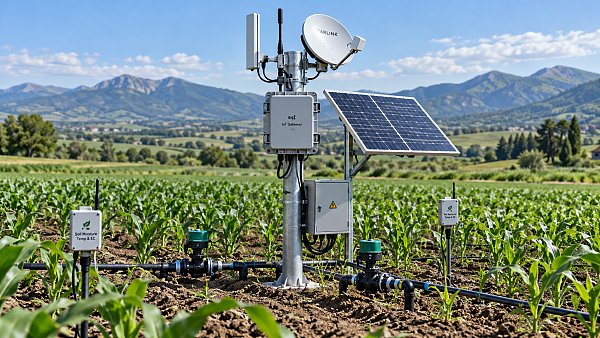
A hybrid design can combine local sensing, gateway processing, and cellular or satellite backhaul. Its value depends on the independence of its failure paths. Two connections sharing one gateway, battery, antenna mast, or cloud dependency may provide less resilience than expected. The architecture review should identify which failures the second connection actually covers.
Evaluate the complete path through failure and recovery
The most revealing comparison is an end-to-end operating sequence: the device measures or acts, the radio carries the message, the gateway or operator network forwards it, the application interprets it, and an operator or controller responds. Every stage can introduce delay, loss, or ambiguity. Procurement criteria should describe the result required at the application, rather than stopping at network availability.
For irrigation, distinguish command receipt from physical confirmation. A controller acknowledgment establishes that it received an instruction; valve position, flow, or pressure feedback can provide evidence that the intended action occurred. If that feedback fails to arrive, the application needs a defined escalation path. Retrying a command indefinitely can create additional risk.
Delayed delivery also needs explicit handling. Commands should have expiry rules so that an instruction queued during an outage cannot trigger an inappropriate action after reconnection. Timestamped measurements should retain their original sampling time. A dashboard should make stale readings visible instead of presenting the latest available value as though it were current.
Buffering helps preserve observations during a backhaul outage, but it needs limits. Determine which devices can store data, how much they retain, and how they reconcile missing or duplicate records after recovery. For control workloads, specify which instructions may be replayed and which must be discarded. Recovery traffic should not overwhelm routine communications.
Interoperability deserves a practical demonstration. Ask the supplier to move representative data from the proposed device through the actual network into the intended farm-management or control platform. Verify timestamps, units, device identifiers, alarm handling, and command responses. An available API can still require substantial integration work if the data model or access conditions do not fit the application.
Include security and maintenance in that demonstration. Devices should have an appropriate identity and credential-management process, with controlled access to command functions. Evaluators also need a workable method for firmware updates, credential changes, device replacement, and access revocation. These activities can be expensive when every intervention requires a trip to a remote field.
Use a field pilot to settle the decision
A useful pilot covers the difficult locations and operating conditions that could overturn the design. Select obstructed sensor positions, weak cellular areas, distant field boundaries, and installations with constrained power. Where crop growth may change reception, account for that seasonal condition rather than treating a clear-field survey as final acceptance.
Set pass criteria before installation. Evaluate the proportion of measurements delivered within their useful window, command completion with physical confirmation where required, outage detection time, and recovery performance. Measure energy use across ordinary operation, retransmissions, connection attempts, and recovery. A short successful demonstration cannot establish seasonal battery endurance, but measured consumption can improve the energy model.
Deliberately interrupt backhaul and power under controlled conditions. Observe whether local control continues as specified, whether alarms reach the right destination, and whether the system recovers without a field visit. Test the backup connection itself. A configured failover setting provides little assurance until switching and recovery have been demonstrated.
Capacity testing should reflect the proposed deployment. Increase representative traffic to assess channel loading, downlink demand, gateway processing, and backhaul usage. Include bursts such as weather alarms or coordinated reporting. Confirm that the supplier’s capacity claim applies to the intended payloads, reporting intervals, and radio conditions.
Compare ownership cost over the same operating period and service scope. Include devices, antennas, gateways, mounting, power systems, installation, subscriptions, integration, maintenance, and replacement visits. Check how charges respond to additional devices, retransmissions, large uploads, or use of a backup connection. A low recurring fee can lose its advantage if weak coverage drives frequent site work.
The final choice should follow the evidence. Distributed, low-volume monitoring may justify LoRaWAN with dependable backhaul. Direct cellular can be simpler where service and power consumption have been demonstrated at the device locations. Satellite can close a terrestrial coverage gap when its service characteristics match the workload. A hybrid architecture earns its added cost when testing shows that it preserves a necessary function through a defined failure.
Before committing to deployment, require a record of coverage assumptions, measured performance, outage behavior, integration responsibilities, and operating costs. That record gives the technical team a basis for accepting the system—and for recognizing when a new field, denser device population, or different control requirement calls for another design.
The Archive Newsletter
Critical industrial intelligence delivered every Tuesday. Peer-reviewed summaries of the week's most impactful logistics and market shifts.